
How To Lose 10-20 Pounds By Thanksgiving - Part 1
I try not to play favorites with my clients.
I love them all equally, but there's one guy I really appreciate — hard worker, high energy, super positive, always fun to talk to on our check-in calls. Since he started with me, he's gained a ton of strength (repping 205 on the bench and 280 on the trap-bar deadlift, hello!) and built habits that will support his health for the rest of his life.
But he still hasn't lost the fat.
And when I lay awake at night staring at the ceiling, you might expect me to think about my own mortality, my father's mortality, or who to draft third overall in my fantasy football draft this week. But no.
All I can think about is, "How can I help this awesome guy lose the fat?"
So that's what you're getting these next five days. A five-step sequence to help one of my favorite clients lose 10 to 20 pounds by Thanksgiving.
Here's the kicker: this guy already knows what to do.
Calories, steps, strength training a few times a week, sleep, minimizing alcohol. But we could all use a refresher, so I'm covering those today.
The trouble he has — the problem he's enlisted me to solve — is actually doing it. So over the next four days we'll go deeper, bridging the theoretical — what works based on physics and physiology — and the practical — what actually works in his messy life, working 40+ hours a week as a realtor, juggling three kids under 12, and hitting a minimum of three parties a week. (Told you he was cool.)
With that, onto step number one.
What Would an Alien Say?
Strange Planet memes crack me up:
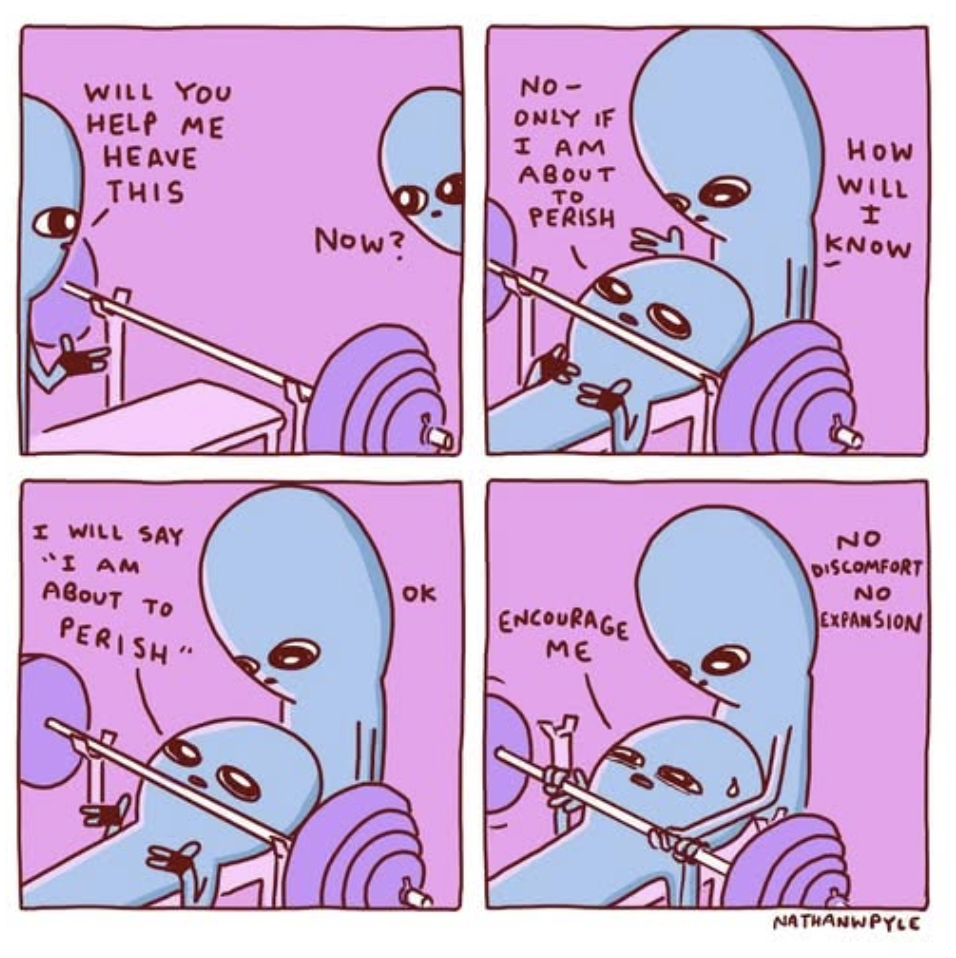
I enjoy them because they highlight how stuff we consider normal is actually quite strange to an outside observer.
When solving the problem of fat loss, I love to start there. Because on the surface, it's so dreadfully simple.
If you moon beamed an alien down and told them 74% of Americans are overweight or obese, they'd say:
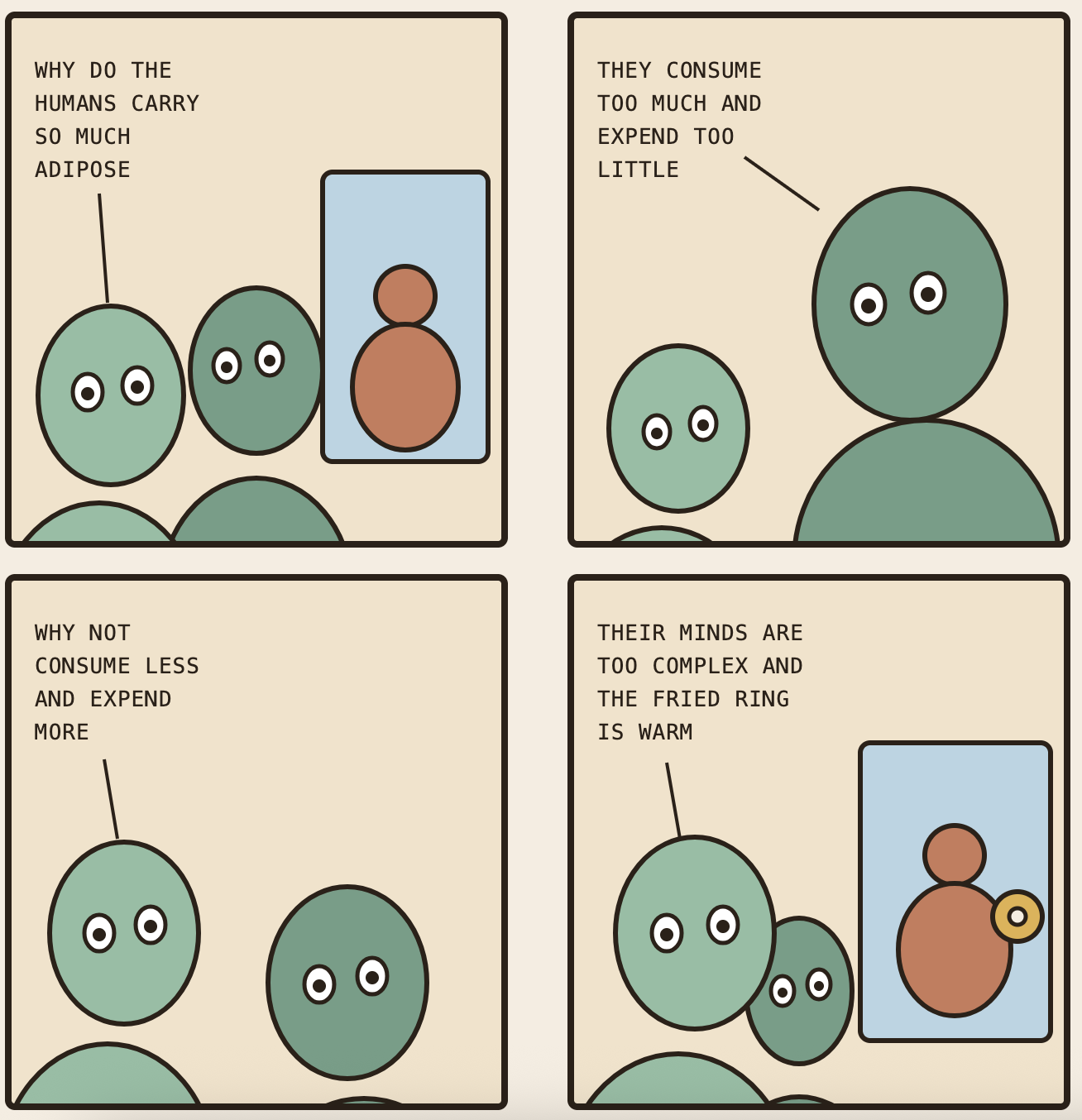
We'll address the mind over the next four days, because it’s the toughest problem to solve.
But first, let's make sure we're all squared away on the basics:
To lose weight, you need to eat fewer calories than you burn
You can do this by moving more, eating less, or some combination of both
To make sure most of the weight you lose is fat (not muscle), you need to eat a lot of protein and strength train a few times a week
No foods or actions are inherently fattening
Carbs don't make you fat. Neither does sugar, alcohol, hormones, or sleeping 4 hours a night
But sometimes they can make it harder to eat less or move more. Which will make you fat.
Again — because millions if not billions in the world don't understand this — the only way to lose fat is by eating fewer calories than you burn.
How many calories should you eat to lose fat?
The ideal number is different for everyone based on their size/gender/age/activity. A great place to start is your bodyweight × 12. I'm 175 lbs, so 175 × 12 is 2,100. That's a decent starting place, and decent is all we need because we’ll adjust from there.
How much protein should you eat to lose fat?
The ideal number is different for everyone based on their size/gender/age/activity. A good place to start is 1 gram of protein per pound of target bodyweight. If I'm 175 lbs and trying to lose 10 pounds, 165g/day would be a decent starting place.
If you're leaner or generally hungrier, you may want to go as high as 1.2 grams per pound. Personally, because I like muscle and dislike hunger, I usually target 180–200g of protein a day during a fat loss phase.
How much fiber should you eat to lose fat?
The more, the better. Fiber is incredibly health promoting and knocks hunger down a few notches.
You want specific numbers? Start at 14g per 1,000 cals you eat. I want my clients leaner and healthier than average, so I'd recommend 20g per 1,000 cals.
Do you need to track your food to lose fat?
I used to tell clients, "If you don't want to track, no problem! We can try other strategies like adding more protein and fiber, cutting portion sizes, drinking more water, etc."
But I'm getting grumpy in my old age. Those strategies work, but not nearly as well as tracking every single thing you put in your mouth.
Every.
Single.
Thing.
Even when you have 4 drinks and 4,000 calories on Saturday.
People hate tracking because it takes time and effort, and it's embarrassing to see you're eating 8,000 more calories than you thought. But the pain of dealing with diabetes or being ashamed of taking your shirt off at the beach far outweighs the pain of tracking your food for 3–6 months. So:

If you desperately needed $10,000 by Thanksgiving — say, because a local bookie has expressed a strong interest in your kneecaps — you wouldn't wing it. You'd pull up your accounts and get real about the numbers. What's coming in, what's going out, and what has to change to get to 10k.
Fat loss runs on the same math, but almost everyone tries to do it on vibes.
Download MyFitnessPal or Cronometer, buy a cheap food scale on Amazon, and track as well as you can. You don't need to be perfect — 70–80% accuracy will do.
How often should you weigh yourself to lose fat?
Every morning after using the bathroom. Write it down in your notes app and move on.
Some days it will be higher, some days lower. We don't care about the daily number — sodium, carbs, water, muscle soreness, food weight, and the powers that be can all impact it.
Track the 7-day average. Generally you want to see it go down 0.5–2 pounds a week. It may be closer to 3–4 pounds at the start from water and glycogen, especially if you have a lot to lose.
If your average weight isn't going down as fast as you'd like after 14 days, cut 200 cals a day or add 4k steps a day and give it another two weeks.
How many steps should you take to lose fat?
“The ideal number is different for everyone based on their”…it is!! 😂 All of these are. But in general, I'd recommend starting at:
8–10k steps a day
There is no magic step number for fat loss. But the higher the number, the more calories you burn. And remember — the only way to lose fat is by burning more calories than you eat.
Plus, every time you go out for your steps, you're signaling that your fat loss goal is important to you. That leads to better food choices, which leads to more fat loss.
Do you need to strength train to lose fat?
Strength training is not required to lose fat. You could be chained up in a basement and still lose weight if your captor fed you fewer calories than you burned.
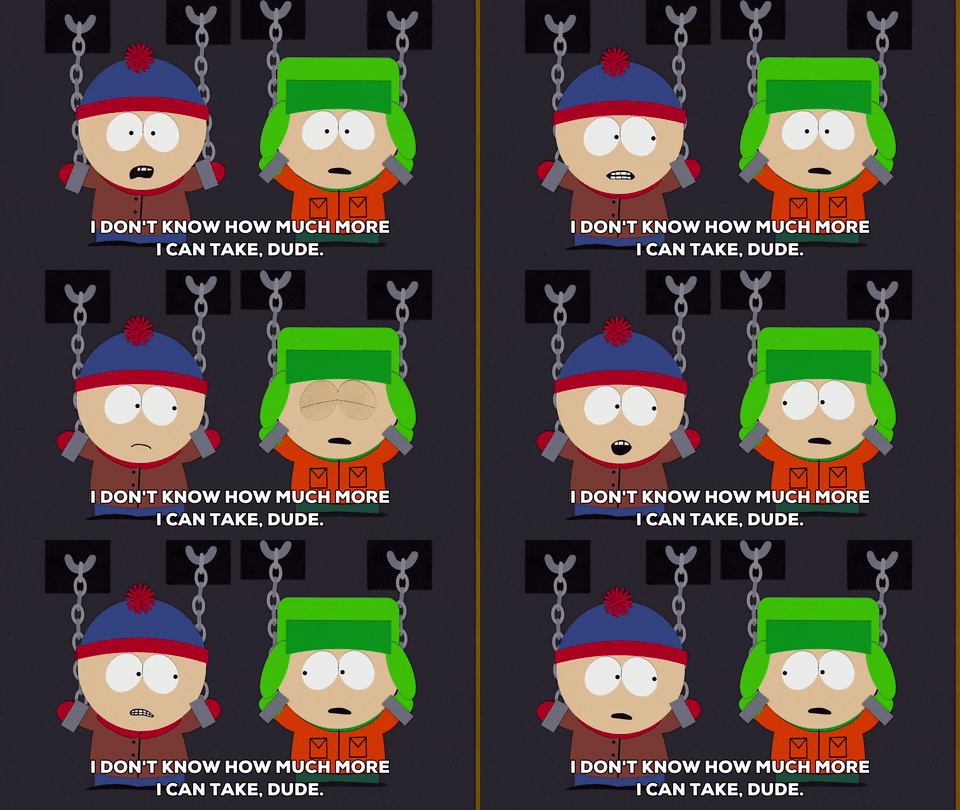
But you'd lose a lot of muscle, and we don't want that. If you're interested in any of the following:
Looking toned
Burning more calories at rest
Getting stronger
Accelerating fat loss
Strength training is essential.
3–4x a week, mostly compound lifts (squats, bench press/push-ups, deadlifts, rows) because they train the most muscles at once, and mostly within 2–4 reps shy of failure — the most effective way to train for muscle gain/retention.
Do you need to do extra cardio to lose fat?
Cardio burns a lot of calories and it's great for health. But a lot of people fall into the trap of only doing cardio. They lose weight, lose more muscle than they'd like, and burn fewer calories at rest than someone who strength trains consistently.
If you have extra time after strength training 3–4x a week, add some cardio. A good starting point is 90–120 minutes a week of moderate-intensity cardio.
Oh, and HIIT isn't inherently fat-burning. It can help you burn more calories faster than steady state cardio, but there's nothing magic about it.
How much do you need to sleep to lose fat?
Ideally, 7–8 hours a night on a somewhat regular schedule.
When you get enough sleep, you'll:
Be less hungry
Naturally move more throughout the day
Recover better between workouts
Support your hormonal health, which makes everything easier mentally and physically
Have fewer waking hours to shove warm fried rings down your gullet
What supplements do you need to lose fat?
None. But:
Protein powder (whey or vegan, doesn't matter) makes it way easier to hit your protein target
Creatine monohydrate, 5–10g a day, might help you build a little more muscle
End of list.
To recap:
The alien was right — to lose fat, eat less and/or move more
To eat less: bodyweight × 12 for your calorie starting point, 1 gram of protein per pound of target bodyweight
To move more: 8–10k steps a day, 3–4 strength training sessions a week, 90–120 minutes of cardio a week
Track calories/protein, steps, and bodyweight. Look at 1–2 week averages, not daily numbers, and adjust if you want faster fat loss
Sleep 7–8 hours a night
Protein powder and creatine for a small boost if you want
That's "all" you have to do to lose 10–20 pounds of fat.
But knowing what to do is the easy part. Actually doing it consistently for a few months is where people struggle.
Tomorrow I'll show you how to increase your odds of success by 100%.
Talk soon,
John
P.S. If you want expert help losing 10-20 pounds before the Turkey hits the oven, apply for coaching today.
3 Steps You Can Take
Apply for coaching - If you’re ready to start, you can fill out a coaching application here (it takes 90 seconds or less). Best case, you change your life. Worst case, I’ll help you draw up a road map to get closer to your goals.
Sign up for my newsletter - If you’d like to hear more, sign up for my mailing list here.
Keep learning - You can check out my other articles here. Nobody asked me to, but I’ve spent a ton of time researching everything from artificial sweeteners to saturated fat to testosterone and more, so you don’t have to.
