
How To Lose 10-20 Pounds By Thanksgiving - Part 5
I've helped hundreds of people lose fat since 2017, and there's one constant among the ones who struggled the most: they weren't clear on what they wanted or why.
You might think, "What the literal F are you talking about John? I want to lose fat and get healthier. It's simple."
But it's not, dear reader.
Because that's like walking into the local Morgan Stanley, sitting down with an advisor, and telling him "I wanna get that schmoney and buy a yacht, show me how."

He wouldn't sit you down and start explaining. He'd call security and tell you to get the hell out of his office.
But if he gave you another shot, he'd ask how much money you want and by when. What's your target net worth? What year are you retiring? And why does any of it matter to you?
People are far more specific and intentional about their money than they are about their own health. Which is bonkers, because you can always make more money. But lose your health and it's game over.
So since we want to keep playing, let's figure out exactly what you want, why, and whether you’re willing to pay the price.
Don't be dumb, be SMART
Yes, I told you the other day that you need to be a little dumb to lose fat, and I stand by it. Be dumb about the daily execution, be SMART about the target.
Let me warn you: goal setting, and SMART goals in particular, is a concept so boring I've watched it put an entire lecture hall of kinesiology students to sleep in three minutes flat. And these are people who want careers in exercise and health!
I didn't realize it at the time, but the quality of your goals dictates the quality of your results. I've never worked with a client who achieved something extraordinary without a specific, ambitious, time bound goal.
What's a SMART goal anyhoo?
SMART stands for:
Specific - "lose 15 pounds" instead of "lean out a little"
Measurable - you can point to a number that says whether you did it
Achievable - hard enough to challenge you, close enough to be doable in 6-12 months
Relevant - it connects to your specific why
Time bound - a specific date on the calendar
Here's the difference in practice.
Not SMART: "I want to lose weight and get in better shape before the holidays."
SMART: "I'm going to weigh 195 by November 26th, hitting 2,100 calories and 180g of protein a day 6 days a week, lifting 3x a week and walking 8,000 steps, so I can take my shirt off at the lake next summer without thinking about it."
Not SMART: "I need to get stronger and stop feeling so beat up all the time."
SMART: "I'm going to deadlift 315 for 5 by March 1st, training 4x a week, so I can carry my kid up the stairs at the end of a long day and not feel it in my back the next morning."
Why does a silly little goal carry so much power? 4 main reasons:
1. They make the daily decision obvious. "Get in better shape" is useless at 9pm when you're standing in the pantry. "2,100 calories and 180g of protein" tells you whether the Chewy Chips Ahoy winking at you at 9pm fits your daily targets.

2. They turn the fuzzy into something you can adjust. As Yogi Berra said, "if you don't know where you are going, you'll end up someplace else." A number lets you look at two weeks of data and say "not moving, cut 200 calories" instead of, "I guess this isn't working for me, my grandparents can kick rocks for giving me these bum-ass genetics."
3. A deadline creates urgency a vague intention never will. "Eventually is the same as never" (put it on a t-shirt!). If you have a goal you want to hit on November 26th, today is important.
4. They protect you from the all-or-nothing spiral. When the goal is 195 by November 26th, one bad Saturday is a rounding error against a 12-week target. When the goal is "be good," one bad Saturday is a total failure. And we at Focus Fitness Coaching are not total failures (another t-shirt idea).
Get clear on your why
Your “why” is the specific, meaningful thing in your life that changes once the weight is gone.
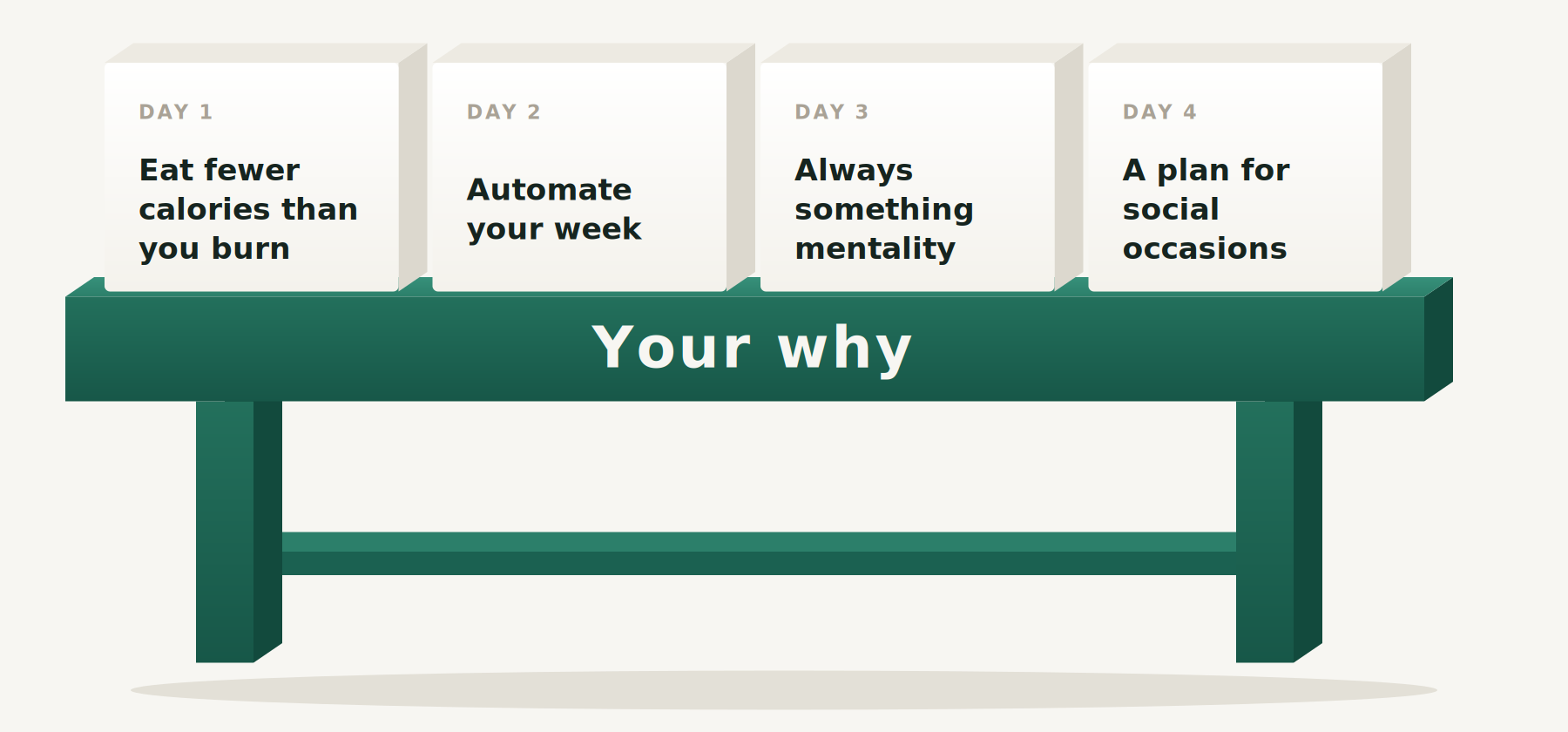
Everything we’ve talked about the last four days - the calorie balance, the automating, the always something mentality, and the plan for social occasions — sits on your “why.”
So on every first call I ask clients what they want and why they want it. And here's where almost everybody stops:
"I want to lose 20 pounds."
That's not a why, my guy! That's a what, and the what was never your problem.
So on every first call I ask the same question, and then I ask it again, and then I usually ask it a third time, because the first answer is almost always a dud. It usually goes something like this:
"I want to lose 20 pounds."
Why?
"Because I don't like how I look right now."
Okay, but why does that matter to you?
And that's where the real answer shows up. Here's how the client you've been hearing about all week put it:
"For the last several years I have not liked how I've looked in those photos, specifically my face/double chin and stomach… even though I've put in a lot of work in the gym and gained strength, I really haven't achieved/maintained any fat loss and was once again sitting at 200ish lbs for photos and not liking how I looked."
THAT is the why. Not the 20 pounds. It's liking how he looks in pictures, and having that self confidence carry into his relationships, his work, and every other aspect of his life.
A few of the whys my clients have landed on in the past few months, lightly disguised:
Being the dad who plays in the pool instead of the dad who watches from the chair
Not repeating what my father's last ten years looked like
Being able to walk into a room and not think about my body for one single second
Those are the kind of things that get you out of bed at 5:30am in the middle of December when staying under the covers feels like heaven.

So do the work. Write out the surface answer, ask why it matters, write that down, and do it again until you land on something that makes you a little uncomfortable, because discomfort is usually the sign you've hit the real thing.
Every goal has a price. Losing 20 pounds costs you a few months of drinking less, snacking less, moving more, and sleeping better, and you don't pay it once, you pay it in ten or twelve installments a day, every time you decide what goes on the plate or whether you're getting your steps in.
A strong why is what makes you willing to pay that price, even (and especially) when you don’t feel like it.
Last, don't let yourself forget about it
The best moment of my high school football career took place in the locker room at halftime, up 30 on a weak sauce team. The upperclassmen had music going on the speakers, an activity usually reserved for after the game was finished. No big deal, we're up thirty, right?
Wrong.
Our coach comes storming in, violently kicks over the speaker, and screams, "WHAT THE F DO YOU THINK YOU'RE DOING?! THE GAME'S NOT F'ING OVER YET!!!!!!!"
I'll never forget it as long as I live.
You see, the coaches hyped us up before the game. Stay focused, don't let up, do your job, finish. An hour later we'd forgotten the assignment, and Coach Gibbs let us know via judo kick to the Bose.
You can have the strongest why in the world, but if you don't revisit it often, you'll forget why it means something to you.
Write it out and refer back to it weekly, maybe even daily. Your fat loss journey may take 6-12 months or more, and somewhere in there you'll stop feeling motivated because you stopped thinking about why you started. Keep it in front of you and the motivation comes back.
That's a wrap
There we go, everything you need to lose 10-20 pounds.
Today - Your why is the table all of it sits on. Without it, the other four topple over.
Speaking of tables, we've got 11 weeks until you plop the turkey and stuffing on yours.
Enough time to walk in 10-20 pounds lighter, feeling the best you have in a while. Even better, you could wake up on Jan 1st already ahead of your goals, instead of hungover and reeking of champagne and despair.
If you'd like a hand with the former rather than the latter, apply for coaching today.
Best,
John
P.S. If you were nodding your head along these past 5 days but aren't sure where to start, now is the best time.
Healthy For The Holidays closes 9/14. Every client who joins gets:
A plan built specifically for you, to lose 10-20 pounds while gaining strength before you sit down for Thanksgiving
A full movement assessment and prehab protocol built into your training program (a $300-$500 value, free)
First dibs on Black Friday coaching promos
100% money back guarantee at any point in the program
27 of my 30 roster spots are already full. Once the last ones are gone, they're GONE. My average client stays 9-12 months, so they may stay that way for a while.
3 Steps You Can Take
Apply for coaching - If you’re ready to start, you can fill out a coaching application here (it takes 90 seconds or less). Best case, you change your life. Worst case, I’ll help you draw up a road map to get closer to your goals.
Sign up for my newsletter - If you’d like to hear more, sign up for my mailing list here.
Keep learning - You can check out my other articles here. Nobody asked me to, but I’ve spent a ton of time researching everything from artificial sweeteners to saturated fat to testosterone and more, so you don’t have to.
